Fever and illness in a baby: when to call and when to go to A&E
If your baby is under 3 months old and has a temperature of 38 ºC or more, get advice straight away, without waiting to see how it goes. In older babies, what decides is how your child is, not just what the thermometer says.
Published on November 11, 2026.
Download on the App Store · iPhone
First, measure properly and write it down
A baby with a fever makes anyone nervous, and nerves make you forget the details. Before calling, have four things ready: the temperature and how you took it (armpit, ear or rectal), what time it started, how much they have eaten in the last few hours and how many wet nappies they have had today.
A fever is 38 ºC or above. A tenth of a degree either way does not matter. What counts is your baby's age and appearance. Note each reading with its time, because the paediatrician or the A&E doctor will ask how it has developed, and from memory everything gets mixed up.
There is no need to undress them completely or wrap them up warmly. Light clothes and a room that is not too hot. Medicines, doses and intervals are always decided by your paediatrician or the service advising you by phone, according to your child's weight and age.
Under 3 months: do not wait
In a baby under 3 months, 38 ºC or more needs urgent attention even if they look calm. Their defences are still immature and an infection can progress fast without giving many clues. Call your health centre if it is open or go to paediatric A&E if it is not.
The same goes if, without a fever, they are much sleepier than usual, seem floppy or refuse several feeds in a row. In the youngest babies, being unwell sometimes shows in behaviour before it shows on the thermometer.
Signs that mean A&E or 112
At any age, take your baby to A&E, or call 112 if you cannot get them there safely, when you see any of these signs:
- Fast or laboured breathing, with the ribs sucking in, or grunting as they breathe.
- Blue or very pale lips, face or tongue.
- Spots on the skin that do not fade when you stretch it or press a clear glass on them.
- They are very drowsy, hard to wake, unresponsive or crying in a way you do not recognise.
- Seizures, or a stiff neck with refusal to look down.
- Repeated vomiting, green or bloody vomit, or blood in the stools.
- They have gone more than 6 to 8 hours without a wee, have a dry mouth or a sunken fontanelle.
These are the warning signs listed by paediatric associations, such as the Spanish Association of Paediatrics. If you are unsure whether to call, call: nobody will reproach you for one consultation too many.
Over 3 months: look at the child, not just the number
After 3 months, a baby with a fever who feeds, smiles, plays a little between temperature spikes and wets nappies can usually wait for an appointment the next day. A baby with 38.5 ºC who is listless, cries when touched or does not want to feed deserves more attention than another with 39 ºC who is still smiling.
Book an appointment or call the health centre if the fever lasts more than 48 hours, if it drops and comes back up after several days, if a runny nose, cough or diarrhoea is not improving or if you notice ear pain, tummy pain or pain when weeing. For symptoms that stay borderline, many regions have a paediatric or nursing advice line; the number is on the health card or on your health service's website.
After a vaccine, some fever or irritability is normal in the first 24 to 48 hours. Ask at the centre what to do in your case and go through the vaccination and check-up schedule to know what is due and when.
What to take to A&E
In the rush you forget exactly what is useful. Take the baby's health card, the vaccination record, the ID of whoever goes with them and a clean nappy with a change of clothes. If they take any medication or have known allergies, take it written down.
As well as the readings, say when the illness started, what they have eaten and vomited, how many nappies they have wet and whether they have been near anyone ill.
Temperature and a PDF for the appointment
In Meceluna, the + button on the Home screen lets you log the temperature with its time, alongside feeds and nappies. What one of you logs, the other sees on their iPhone, so whoever stays up with the baby at dawn and whoever arrives in the morning have the same record.
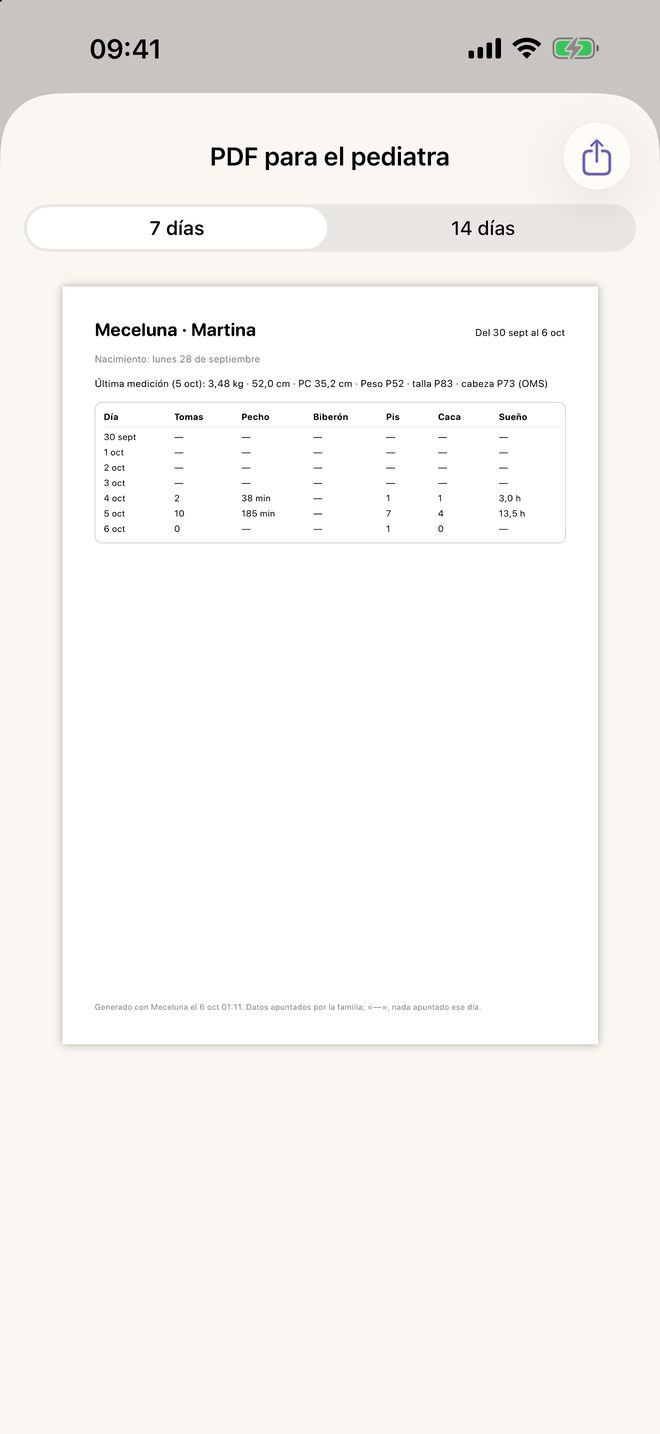
When it is time for an appointment, the PDF of the last 7 or 14 days gathers the days with the temperature and medication if you have logged them. It is a summary to show the doctor, never a diagnosis: the professional is the one who assesses your baby. The record of feeds, nappies and sleep has its own page.
Frequently asked questions
At what temperature does a baby have a fever?
A fever is 38 ºC and above. Under 3 months it needs urgent attention, and in older babies their appearance matters more than the number.
How long can a baby have a fever before seeing a doctor?
Under 3 months, you do not wait. In older babies, get advice if the fever goes on for 48 hours or gets worse, if any warning sign appears or if you are simply worried.
What number do I call if the baby is very unwell?
112, which is free across Spain. If it is not an emergency, your health centre or your region's advice line.
Is it normal to have a fever after a vaccine?
A little fever or irritability a day or two afterwards is common. If it is high, lasts longer or there are other signs, talk to your paediatrician.
The essentials of Meceluna are free and have no ads.
Download on the App Store · iPhone