Fever and illness in a baby: when to call and when to go to the ER
If the baby is under 3 months and has 38 °C or more, you need to consult right away, without waiting to see how it goes. For older babies, what decides is how the child looks, not only what the thermometer says.
Published on November 11, 2026.
Download on the App Store · iPhone
First, measure properly and write it down
A baby with a fever makes anyone nervous, and nerves make you forget details. Before calling, have four things ready: the temperature and how you took it (armpit, ear or rectal), what time it started, how much the baby has eaten in the last few hours and how many wet diapers so far today.
Fever is counted from 38 °C. A tenth of a degree up or down makes no difference. Age and appearance weigh more. Write down each reading with its time, because the pediatrician or the ER doctor will ask how it has changed, and from memory everything blends together.
There is no need to undress the baby completely or bundle them up. Light clothing and a room that isn't too warm. Medication, doses and intervals are always decided by your pediatrician or the service that advises you by phone, based on the child's weight and age.
Under 3 months: you don't wait
In a baby under 3 months, 38 °C or more is a reason for an urgent consultation even if the baby looks calm. Their defenses are still immature and an infection can move fast without giving many clues. Call your health center if it's open, or go to the pediatric ER if it isn't.
The same goes if, without a fever, the baby is much sleepier than usual, seems limp or refuses several feeds in a row. In the youngest babies, being unwell sometimes shows in behavior before it shows on the thermometer.
Signs that call for the ER or 112
At any age, take the baby to the ER, or call 112 if you can't get there safely, when you see any of these signs:
- Breathing fast, with effort, ribs pulling in, or grunting while breathing.
- Bluish or very pale lips, face or tongue.
- Skin spots that don't fade when you stretch the skin or press with a clear glass.
- Very listless, hard to wake, unresponsive, or crying in a way you don't recognize.
- Seizures, or a stiff neck with refusal to look down.
- Repeated vomiting, green or bloody vomit, or bloody stools.
- No urine for more than 6 to 8 hours, a dry mouth or a sunken soft spot.
These are the warning signs listed by pediatric associations such as the Spanish Association of Pediatrics. If you're unsure whether to call, call: nobody will blame you for one consultation too many.
Over 3 months: look at the child, not just the number
After 3 months, a baby with a fever who eats, smiles, plays a little between temperature spikes and wets diapers can usually wait for the next day's appointment. A baby with 38.5 °C who is dull, cries when touched or won't eat deserves more attention than another with 39 °C who keeps smiling.
Book an appointment or call the health center if the fever lasts more than 48 hours, if it drops and comes back after several days, if a runny nose, cough or diarrhea don't improve, or if you notice ear pain, belly pain or pain when peeing. For symptoms that stay borderline, many regions have a pediatric or nursing advice line; the number is on the health card or on your health service's website.
After a vaccine, some fever or fussiness in the first 24 to 48 hours is normal. Ask at the health center what to do in your case, and review the vaccine and checkup schedule to know what is due and when.
What to bring to the ER
In the rush, the useful things get forgotten. Take the baby's health card, the vaccine record, the ID of whoever goes along, and a clean diaper with a change of clothes. If the baby takes medication or has known allergies, bring it written down.
Besides the readings, say when the illness started, what the baby has eaten and vomited, how many diapers were wet and whether there has been contact with anyone sick.
Temperature and a PDF for the appointment
In Meceluna, the + button on the Home screen lets you log the temperature with its time, alongside feeds and diapers. What one of you logs, the other sees on their iPhone, so whoever stays with the baby in the early hours and whoever arrives in the morning have the same record.
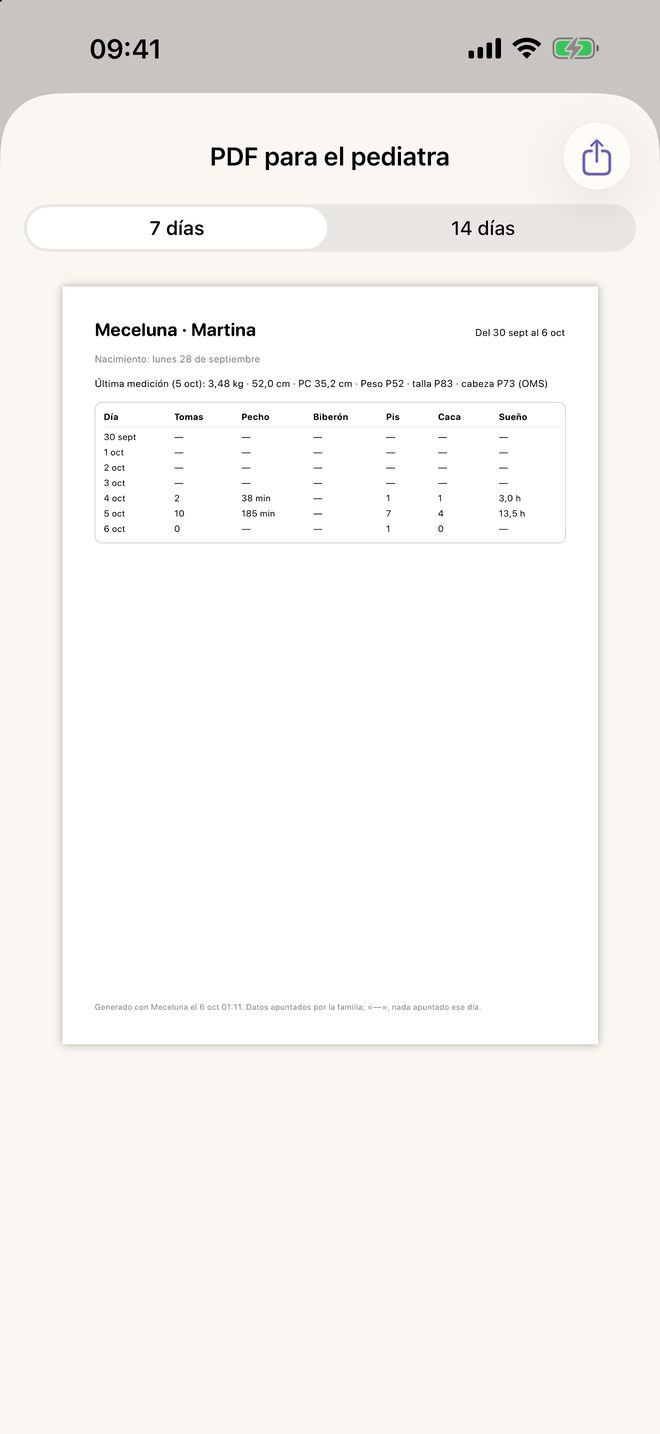
When it's time to see the doctor, the PDF of the last 7 or 14 days gathers the days with the temperature and the medication if you've logged them. It is a summary to show the doctor, never a diagnosis: the professional is the one who assesses the baby. The log of feeds, diapers and sleep has its own page.
Frequently asked questions
At what temperature does a baby have a fever?
Fever means 38 °C or more. In babies under 3 months it is a reason for an urgent consultation, and in older ones the baby's appearance weighs more than the number.
How long can a baby have a fever before seeing a doctor?
If the baby is under 3 months, you don't wait. For older babies, consult if 48 hours go by with a fever, if it gets worse, if any warning sign appears or if you are simply worried.
What number do I call if the baby is very sick?
112, which is free throughout Spain. If it isn't an emergency, your health center or your region's advice line.
Is it normal to have a fever after a vaccine?
A little fever or fussiness one or two days afterward is common. If it is high, lasts longer or there are other signs, check with your pediatrician.
The essentials of Meceluna are free and have no ads.
Download on the App Store · iPhone