How to arrive at the paediatrician with the details of the last few days
The appointment is short and memory at three in the morning is unreliable. With one sheet summarising the last few days, the measurements and your questions, those minutes go much further.
Published on November 11, 2026.
Download on the App Store · iPhone
What the paediatrician almost always asks
Although every professional has their own style, the same questions come up at a check-up. How the baby feeds and how often, how many nappies they wet and what their poos are like, how much they sleep and how, what they do when awake and whether they have had a fever, a runny nose or any odd episode since the last visit.
Answering precisely is hard when there are two of you looking after the baby and each saw part of the day. That is why someone has to keep a note, even if it is in the notes on a phone, and both of you need to see the same thing.
Documents you should not forget
Put them in a folder or in the pushchair bag so you do not hunt for them at the last minute:
- The baby's health card and one parent's.
- The child health record or booklet you were given at the hospital or the health centre.
- The vaccination record, with dates and batch numbers if you have them.
- Discharge reports, scans or screening tests from the first few weeks.
- The list of medication and known allergies, if there are any.
If your baby was born before 37 weeks, mention the gestational age. Measurements are read using corrected age, which we explain in corrected age for premature babies.
Weight, length and head circumference
At each check-up the baby is measured and weighed and their head circumference is noted. The result is placed on growth curves, the WHO ones in most centres. What counts is the trajectory: that your baby more or less follows their own curve from one check-up to the next, not the exact position on the chart.
Keep the measurements from each visit together. If you can see the progress drawn out, it will be easier to follow your paediatrician's explanations. There is more detail in growth and percentiles. Judging whether a curve is right is for the professional.
A few days of records is enough
You do not need to note everything from birth. If you are worried about something specific, such as your baby feeding little, crying a lot in the evenings or sleeping in fragments, a week or two of records gives a much more reliable picture than memory. For a routine check-up, three or four days of feeds, nappies and sleep are enough.
Also note what does not fit any box: a mark on the skin, a vomit that caught your eye, a noise when breathing. If you can, take a photo or a short video of the moment. Sometimes what happens at home does not happen in front of the doctor.
Questions, in writing
We all leave the appointment remembering the question we did not ask. Write them beforehand, in order of importance, because if time is short the first ones will be answered. Some that often come up: when to start other foods, what to do about pending vaccines, how the weight is going, when to start nursery.
Write the answers down at the time. Advice given out loud, such as how much and when, is forgotten before you get home.
The PDF for the appointment
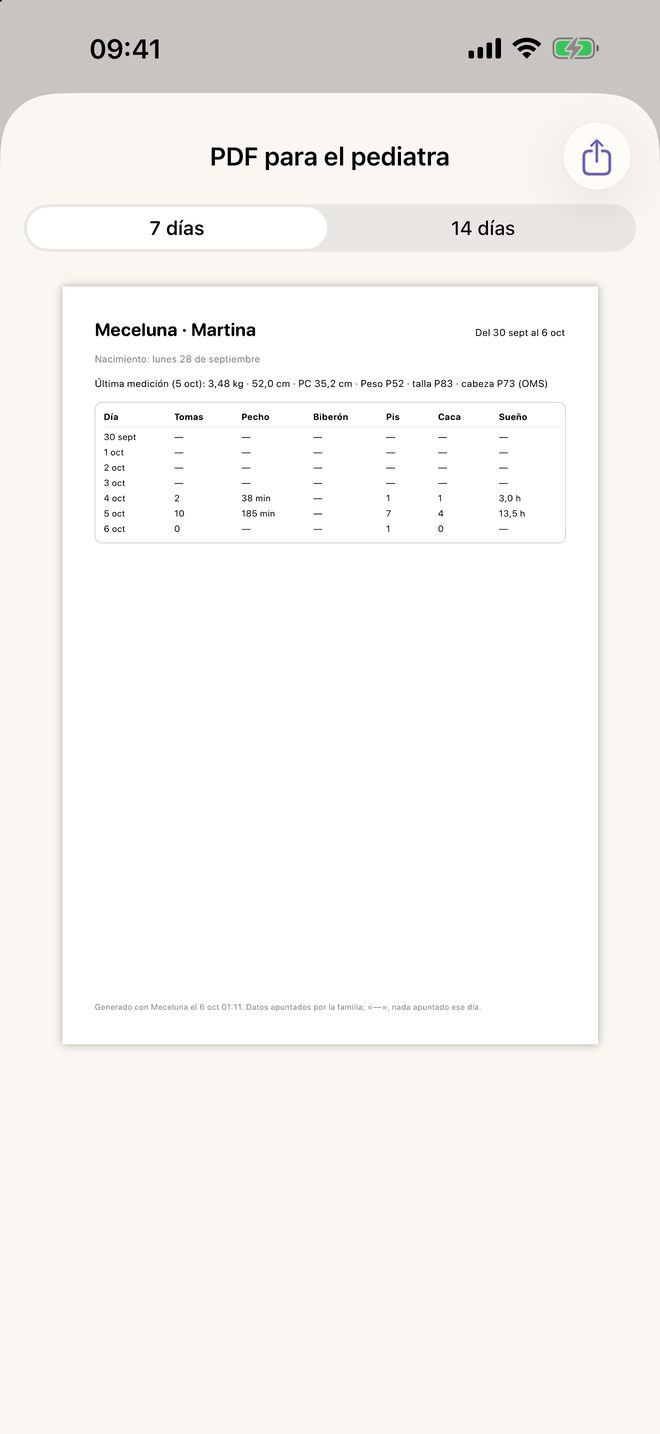
In Meceluna, whatever one of you logs appears on the other's iPhone, so the record gets completed between the two of you without sending each other messages. A temperature, a note or medication is kept with its date and time.
From the Baby tab you can generate a PDF covering the last 7 or 14 days: a summary of each day, the temperature and medication if you have logged them, and your questions. You show it at the appointment or send it by email. The measurements from each check-up are plotted on the WHO curves, with corrected age where it applies. The full record can also be exported as CSV. The report has its own place on the page about Apple Watch, widgets and the report for the paediatrician.
Frequently asked questions
What do I need to take to my baby's check-up?
The health card, the health or vaccination booklet, recent reports, medication or allergies if there are any and a list of your questions.
How many days of feed and nappy records do I need?
For a routine check-up, three or four days are enough. If something specific is worrying you, one or two weeks give a clearer picture.
Can I take data from my phone to the paediatrician?
Yes, and many professionals appreciate it. A PDF or a screenshot covering the last few days can be read in seconds.
Who interprets the growth curves?
Your paediatrician. The curves show your baby's trajectory, but whether it is right depends on each child.
The essentials of Meceluna are free and have no ads.
Download on the App Store · iPhone