How to arrive at the pediatrician's with the data from the last few days
The appointment is short and memory at three in the morning fails. With a sheet that sums up the last few days, the measurements and your questions, those minutes go much further.
Published on November 11, 2026.
Download on the App Store · iPhone
What the pediatrician almost always asks
Each professional has their own style, but the same questions come up at a checkup. How the baby eats and how often, how many diapers they wet and what their stools look like, how much and how they sleep, what they do when awake and whether they have had fever, a runny nose or anything unusual since the last visit.
Answering precisely is hard when two of you share the care and each saw a part of the day. That is why someone has to keep track, even in the notes app on a phone, and both of you need to see the same thing.
Documents you should not forget
Put them in a folder or in the stroller bag so you are not searching at the last minute:
- The baby's health card and one parent's.
- The child health record or booklet you were given at the hospital or the health center.
- The vaccine record, with dates and lot numbers if you have them.
- Discharge reports, ultrasounds or screening tests from the first weeks.
- The list of medication and known allergies, if any.
If your baby was born before 37 weeks, mention the gestational age. Measurements are read with corrected age, which we explain in corrected age for premature babies.
Weight, length and head circumference
At each checkup the baby is measured and weighed and their head circumference is recorded. The result is placed on growth charts, the WHO ones in most centers. What counts is the trajectory: that the baby follows more or less their own curve from one checkup to the next, not the exact position on the graph.
Keep the measurements from each visit so you have them together. If you see the progress drawn out, your pediatrician's explanations will be easier to follow. There is more detail in growth and percentiles. Judging whether a curve is appropriate is up to the professional.
A few days of records is enough
You do not need to write everything down from birth. If you are worried about something specific, like eating little, crying a lot in the evenings or sleeping in pieces, a week or two of records gives a much more reliable picture than memory. For a routine checkup, three or four days of feeds, diapers and sleep are enough.
Also note what does not fit in any box: a mark on the skin, a vomit that caught your attention, a noise when breathing. If you can, take a photo or a short video at the time. Sometimes what happens at home does not happen in front of the doctor.
Questions, in writing
We all leave the appointment remembering the question we did not ask. Write them down beforehand, in order of importance, because if time is short the first ones will get answered. Some that often come up: when to start other foods, what to do about pending vaccines, how the weight is going, when to start day care.
Write down the answers on the spot. An instruction given out loud, like how much and when, is forgotten before you get home.
The PDF for the appointment
In Meceluna, what each of you logs shows up on the other's iPhone, so the record fills in between the two of you without sending each other messages. Temperature, a note or medication stay with their date and time.
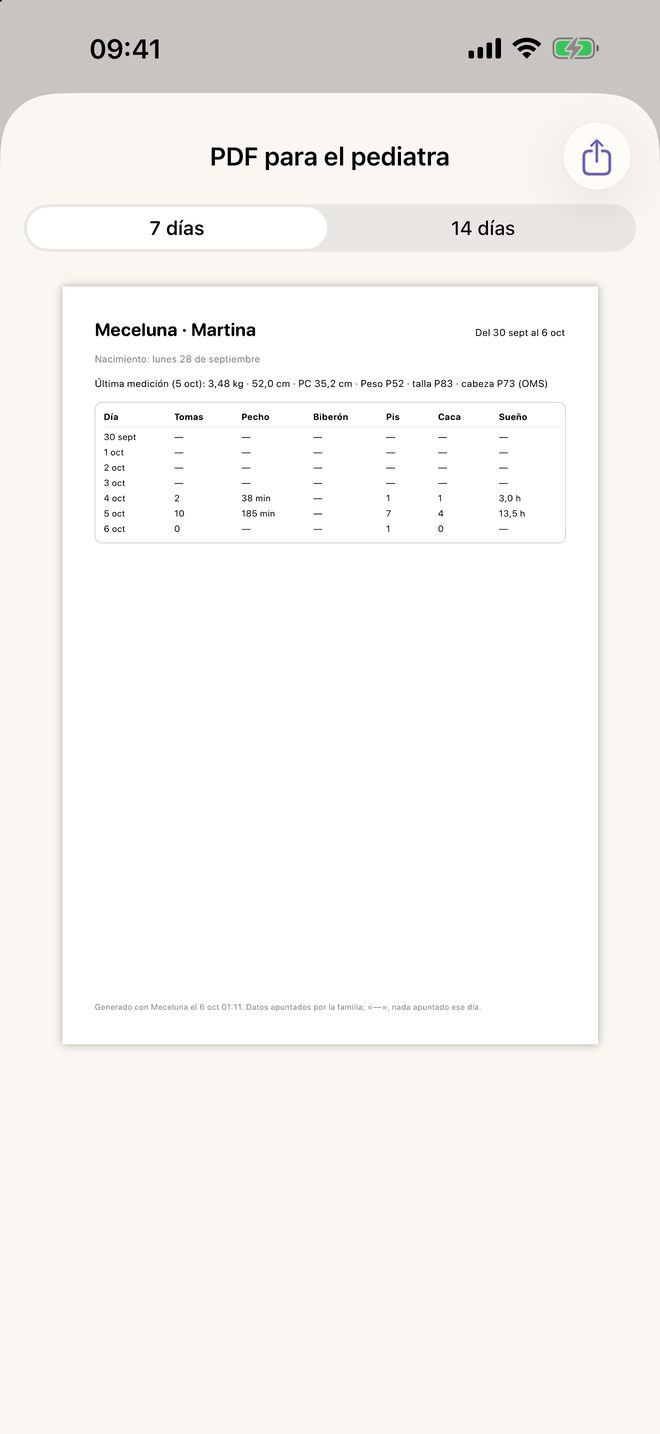
From the Baby tab you generate a PDF with the last 7 or 14 days: a summary of each day, temperature and medication if you logged them, and your questions. You show it at the appointment or send it by email. The measurements from each checkup are plotted on the WHO curves, with corrected age if it applies. The full log can also be exported as CSV. The report has its place on the page about Apple Watch, widgets and the report for the pediatrician.
Frequently asked questions
What do I need to bring to the baby's checkup?
The health card, the health or vaccine booklet, recent reports, medication or allergies if there are any, and a list of your questions.
How many days of feed and diaper records do I need?
For a routine checkup, three or four days are enough. If something specific worries you, one or two weeks give a clearer picture.
Can I take the data from my phone to the pediatrician?
Yes, and many professionals appreciate it. A PDF or a screenshot of the last few days can be read in seconds.
Who interprets the growth charts?
Your pediatrician. The charts show the baby's trajectory, but judging whether it is appropriate depends on each child.
The essentials of Meceluna are free and have no ads.
Download on the App Store · iPhone