Weight and length percentiles: what they mean and why not to obsess over them
A percentile compares your baby with 100 babies of the same age and sex. Being on the 25th percentile means 25 weigh less and 75 weigh more, and it is just as normal as being on the 75th. What the paediatrician looks at is the curve, not a single number.
Published on November 10, 2026.
Download on the App Store · iPhone
What a percentile is
Picture 100 babies of the same age and sex lined up from lightest to heaviest. The one in position 50 is on the 50th percentile, the median. The one in position 10 is on the 10th, and so on. A baby on the 10th percentile for weight is heavier than 10 of those 100 and lighter than 90. It is not a mark or a score.
In Spain, paediatricians use the WHO charts, built from breastfed babies in several countries. There is one chart for boys and one for girls, each with curves for weight, length and head circumference. The lines usually drawn are the 3rd, 15th, 50th, 85th and 97th percentiles, and anything between the 3rd and the 97th is considered the usual range.
50 is not the target
Families often worry because their baby is on the 15th percentile or the 90th. If the parents are tall, it is normal for the baby to sit near the top. If they are short, near the bottom. A healthy baby can be anywhere in the range. A baby on the 5th does not necessarily eat too little, and one on the 95th does not eat too much.
Nor is the aim to "move up a percentile". Extra feeds or spoonfuls do not change the build a baby was born with. It is enough that they grow steadily and are well.
It is the curve that counts
The paediatrician compares each measurement with the earlier ones. A baby who follows their own curve, say always close to the 30th percentile, is doing well. What can catch attention is a sudden change that crosses two main curves, or a baby who stops gaining weight over several check-ups. Each case is then looked into, often with a simple review of feeding.
There are times when the curves shift and nothing is wrong. In the first week almost all babies lose up to 7 or 10 per cent of their birth weight and regain it by about two weeks. Between 3 and 6 months it is common for them to change lane. And short illnesses slow weight gain for a while.
The way babies grow also depends on how they are fed: breastfed babies tend to put on weight a little faster in the first weeks and a little slower afterwards, and the WHO charts use them as the reference. If the paediatrician asks to weigh your baby more often, it is only to see the trend, not because there is a problem.

When not to wait for the check-up
Speak to the paediatrician, without waiting for the next check-up, if your baby:
- Has not regained their birth weight by 2 weeks.
- Is losing weight or has not gained for several check-ups.
- Has fewer wet nappies than usual or seems listless.
- Vomits forcefully after every feed or has diarrhoea that does not clear up.
This text is for information only: reading a curve is a job for your paediatrician, who knows your baby.
Premature babies and corrected age
If your baby was born before 37 weeks, for the first two years their measurements are plotted by corrected age, meaning the age they would be had they been born on their due date. There is more detail in corrected age in premature babies. For very premature babies, the hospital may use other, specific charts.
Each visit's measurements, on the curve
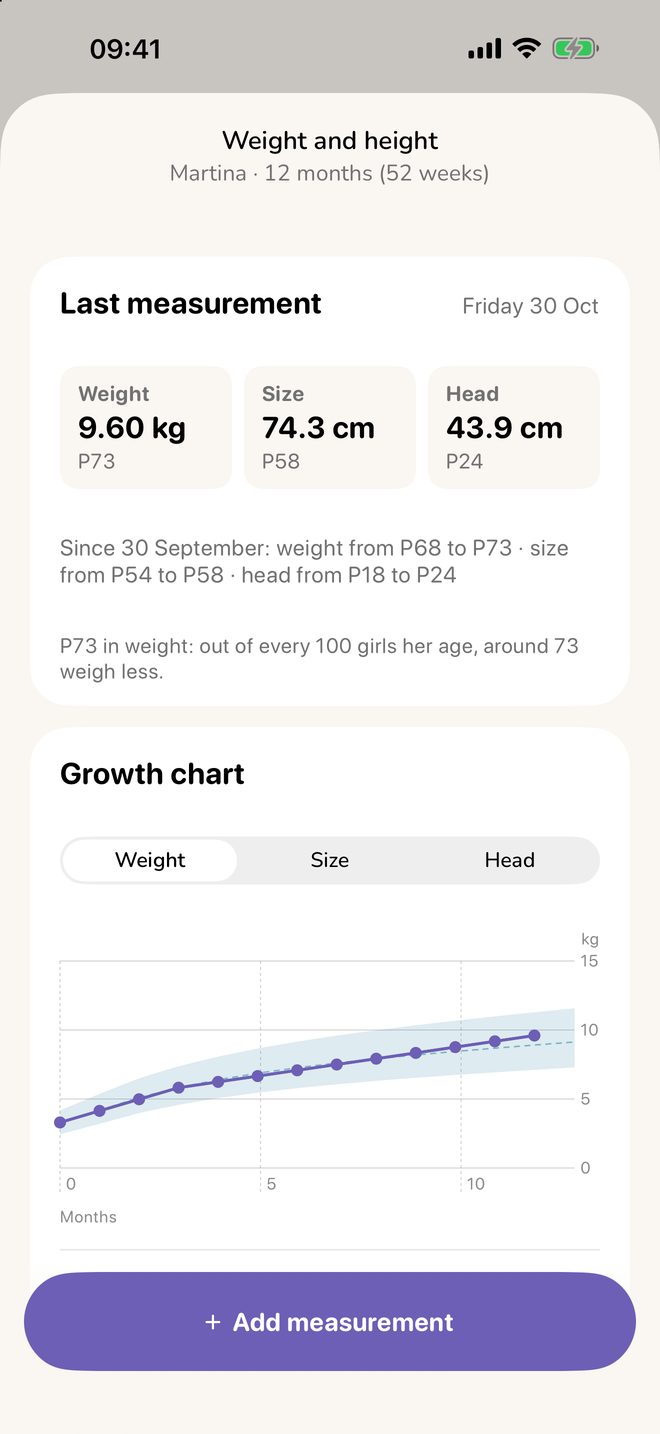
With the + button in Meceluna you note down your baby's weight, length and head circumference from each check-up, and they are plotted on the WHO curves (boy or girl, up to 2 years), with the percentile of each measurement and the corrected age if needed. Each visit adds one dot to the curve. You will find it in weight, length and percentiles. Interpreting it is up to your paediatrician. Appointment dates are in well-child check-ups.
Frequently asked questions
What weight percentile is normal for a baby?
Anything between the 3rd and the 97th is considered within the range. What matters is that the baby follows their own curve, not the number.
Is it bad if my baby is on the 5th percentile?
Not necessarily. If they are growing steadily and are well, it is normal. The paediatrician watches how it develops at check-ups.
Which charts are used in Spain?
Usually the WHO ones, with separate curves for boys and girls. For very premature babies the hospital may use others.
Can feeding change the percentile?
No. A baby's build sets their curve. What you are looking for is steady growth, not a higher percentile.
The essentials of Meceluna are free and have no ads.
Download on the App Store · iPhone