Weight and length percentiles: what they mean and why not to obsess over them
A percentile compares your baby with 100 babies of the same age and sex. Being at the 25th percentile means 25 weigh less and 75 weigh more, and it is just as normal as being at the 75th. What the pediatrician looks at is the curve, not a single number.
Published on November 10, 2026.
Download on the App Store · iPhone
What a percentile is
Picture 100 babies of the same age and sex lined up from lightest to heaviest. The one in position 50 is at the 50th percentile, the median. The one in position 10 is at the 10th, and so on. A baby at the 10th percentile for weight weighs more than 10 of those 100 and less than 90. It is not a grade or a score.
In Spain, pediatricians use the WHO charts, built from breastfed babies in several countries. There is one chart for boys and another for girls, and each has curves for weight, length and head circumference. The 3rd, 15th, 50th, 85th and 97th percentiles are usually drawn, and everything between the 3rd and the 97th counts as the usual range.
50 is not the goal
It is very common for a family to worry because their baby is at the 15th percentile or the 90th. If the parents are tall, it is normal for the baby to be near the top. If they are short, near the bottom. A healthy baby can be anywhere in the range. A baby at the 5th does not necessarily eat too little, and another at the 95th does not eat too much.
Nor is the aim to "move up a percentile". Extra feeds or spoonfuls do not change the build a baby was born with. Steady growth and a baby who is doing well are enough.
The curve is what counts
The pediatrician compares each measurement with the earlier ones. A baby who grows along their own curve, say always close to the 30th percentile, is doing fine. What can stand out is a sudden shift across two main curves, or a baby who stops gaining weight over several checkups. In that case each situation is looked at individually, often starting with a simple review of feeding.
Sometimes the curves move and nothing is wrong. In the first week almost every baby loses up to 7 or 10 percent of their birth weight and regains it by around two weeks. Between 3 and 6 months it is common to switch lanes. And short illnesses slow weight gain for a while.
The way babies grow also changes with the type of feeding: breastfed babies tend to gain a little faster in the first weeks and a little slower afterward, and the WHO charts use them as the reference. If the pediatrician asks to weigh your baby more often, it is only to see the trend, not because there is a problem.

When not to wait for the checkup
Talk to the pediatrician, without waiting for the next checkup, if your baby:
- Has not regained their birth weight by 2 weeks.
- Is losing weight or has gone several checkups without gaining.
- Wets fewer diapers than usual or seems listless.
- Vomits forcefully at every feed or has diarrhea that does not stop.
This text is for information only: reading a curve is a job for your pediatrician, who knows your baby.
Preemies and corrected age
If your baby was born before 37 weeks, for the first two years their measurements are plotted by corrected age, that is, the age they would be if they had been born on the due date. There is more detail in corrected age for premature babies. For very premature babies, the hospital may use other, specific charts.
Each visit's measurements, on the curve
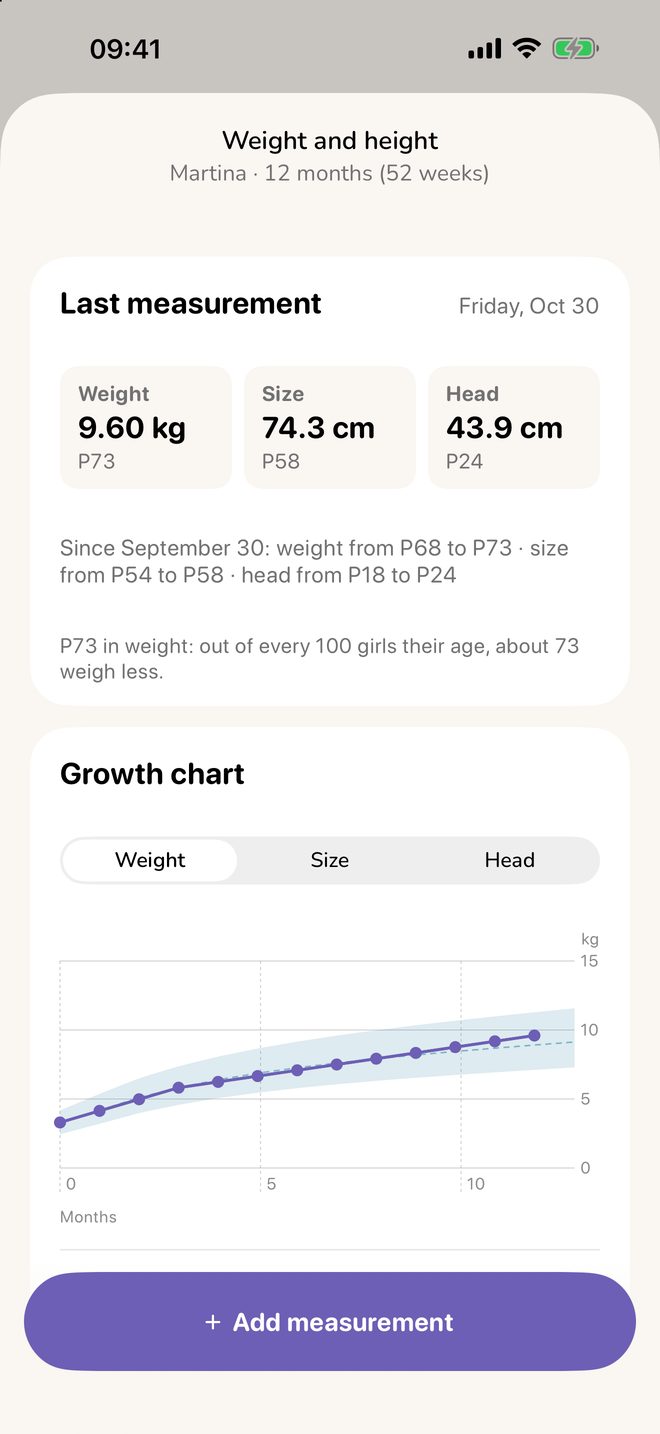
With the + button in Meceluna you log your baby's weight, length and head circumference at each checkup, and they are plotted on the WHO curves (boy or girl, up to 2 years), with the percentile of each measurement and the corrected age if needed. Every visit adds a point to the curve. You will find it in weight, length and percentiles. Your pediatrician is the one who interprets it. The dates of the appointments are in well-child checkups.
Frequently asked questions
What weight percentile is normal for a baby?
Anything between the 3rd and the 97th counts as within the range. What matters is that your baby follows their curve, not the number.
Is it bad if my baby is at the 5th percentile?
Not necessarily. If growth is steady and your baby is doing well, it is normal. The pediatrician looks at the trend over the checkups.
Which charts are used in Spain?
Usually the WHO charts, with separate curves for boys and girls. For very premature babies the hospital may use others.
Can feeding change the percentile?
No. A baby's build sets their curve. What you look for is steady growth, not moving up a percentile.
The essentials of Meceluna are free and have no ads.
Download on the App Store · iPhone