What nappies tell you: wee, poo and when to get advice
A nappy says a lot about how your baby is feeding. In the first week you expect as many wet nappies as days old, up to about 6 a day, and the poo changes from black to green to yellow.
Published on November 7, 2026.
Download on the App Store · iPhone
The first days
On the first day you expect at least one wet nappy, on the second at least two, and so on until the fifth or sixth day, when it is usually 6 or more in 24 hours. At the start there is very little urine and it can be darker, and even leave an orange or pink stain in the nappy (these are urates, normal in the first 2 or 3 days).
The first poo is called meconium: it is black or very dark green, sticky and odourless. It is passed in the first 24 to 48 hours. If two days go by and there has been none, tell the hospital staff or your paediatrician.
How poo changes
At 3 or 4 days the poo lightens: it goes green, then yellowish brown. By about the fifth day it should be yellow.
With breastfeeding it is usually soft, a little runny, with little bits like seeds, mustard yellow and a mild smell. With formula it is usually more pasty, from yellow to brown, with a stronger smell. Both are normal.
Frequency varies a lot. A breastfed baby may poo at every feed or go several days without, and if it then comes out soft and plentiful, there is no problem. With formula, one or more a day is usual. More important than the number is the consistency: if it is hard, in pellets or dry, and your baby strains a lot, mention it to your paediatrician.
Wet nappies: how many are enough
From the fifth or sixth day, 6 or more really wet nappies every 24 hours is normal. A really wet nappy is heavy: if you are unsure, pour a few spoonfuls of water into a clean one and feel the difference. With modern nappies, which absorb a lot, it is sometimes hard to tell if one is wet, so the wetness indicator some have is useful.
Urine should be clear or pale yellow. When it is very dark, smells strong or there are fewer nappies than expected, your baby may be taking too little milk.
Signs to call the paediatrician
Talk to your paediatrician or midwife the same day if you see any of these:
- Fewer than 4 wet nappies a day after the first week, or very dark urine.
- White, grey or clay-coloured poo, which can point to a liver or bile duct problem and needs checking soon.
- Poo with red blood, or black after the first days.
- Very watery, plentiful poo several times in a row, especially if there is vomiting or your baby is listless.
- Hard poo that makes your baby cry or bleed.
Call 112 or go to A&E if there is a fever of 38 °C or more in a baby under 3 months, if they are very sleepy and do not wake to feed, if they breathe with difficulty or if the fontanelle is very sunken and they are not wetting nappies. This text is informative and does not replace a check-up.
Skin and changing the nappy
Change the nappy every 2 or 3 hours and always after a poo. Clean from front to back with warm water and a cotton pad, or with fragrance-free wipes, and pat dry before putting on the new nappy. If there is redness, leaving your baby's bottom bare for a few minutes helps. A zinc oxide ointment usually relieves mild redness, and if there are sores, pus or it lasts more than 3 or 4 days, get advice.
The size you need depends on your baby's weight. It is explained in the guide to nappy sizes by weight.
Wee and poo in the history
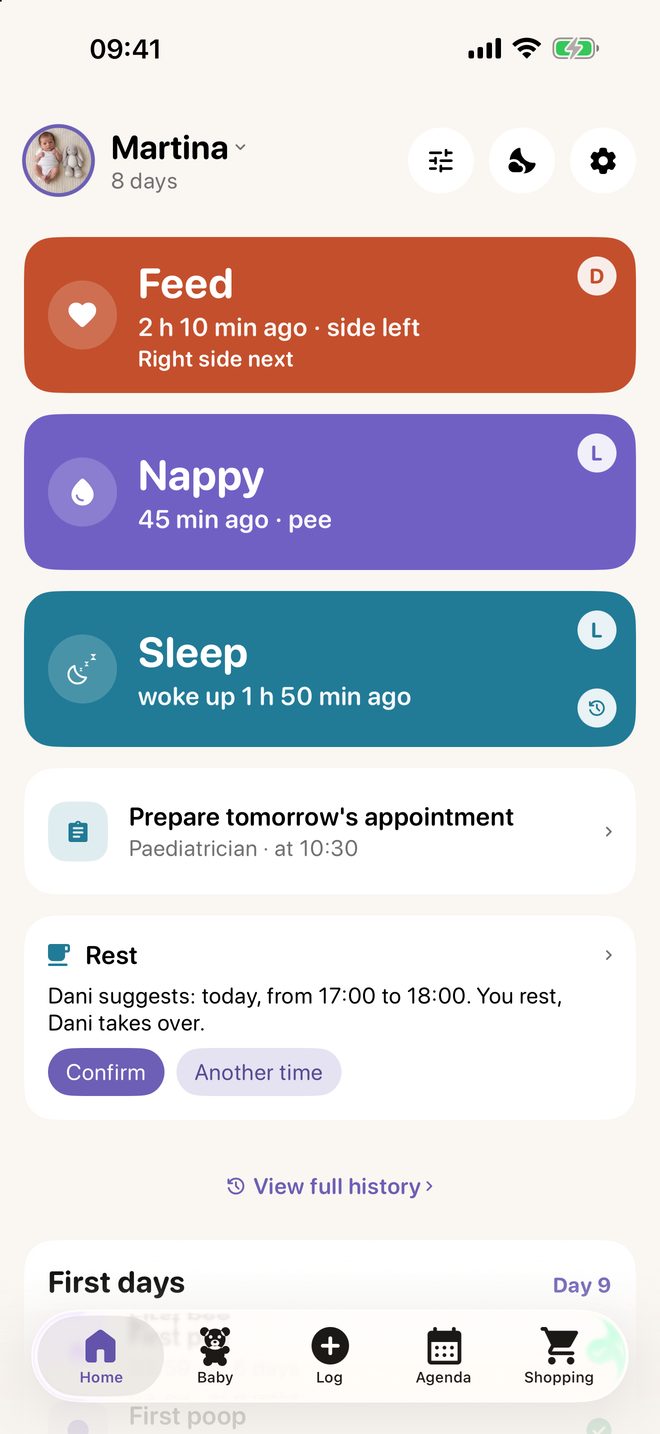
Logging the nappy with one tap, wee, poo or both, gives the paediatrician real data when they ask how many nappies your baby does. Whatever one of you logs, the other sees on their iPhone, and the history can be shown at the appointment. It is in feeds, nappies and sleep, and you can also log from the Apple Watch.
Frequently asked questions
How many wet nappies should a newborn have?
As many as days old during the first week, and from the fifth or sixth day, 6 or more every 24 hours. If there are fewer, get advice.
What colour is a breastfed baby's normal poo?
Mustard yellow, soft or runny, sometimes with bits like seeds. At the start, in the first 2 or 3 days, it is black and sticky (meconium).
Is it normal for my baby to go several days without a poo?
In breastfed babies from 4 to 6 weeks it can happen. If the poo comes out soft and your baby is well, it is usually normal. If they are uncomfortable, with a hard tummy, or the poo is hard, get advice.
When is my baby's poo urgent?
If it is white or grey, has blood in it, or comes with fever, vomiting or listlessness. With a fever of 38 °C or more in under 3 months, A&E or 112.
The essentials of Meceluna are free and have no ads.
Download on the App Store · iPhone