Tracking baby sleep: what it is for and how to read it
Writing down when your baby falls asleep and when they wake up is enough to see how much they sleep in total, what their longest stretch is and how it changes from week to week. It is data, not an exam.
Published on November 5, 2026.
Download on the App Store · iPhone
What tracking sleep is for
In the first weeks everything blurs together: how long have they been asleep, when did they eat, did they sleep or just close their eyes? At three in the morning nobody remembers. Writing it down removes the doubt and avoids arguments, because whoever gets up already knows what happened.
It is also useful for splitting the nights between the two of you, for spotting when there is a bad run and for bringing data to the appointment, which is far more useful than saying they "sleep little".
What you need to log
Two pieces of data: the time they fall asleep and the time they wake up. Everything else comes from that: how long each nap lasted, what the total is over 24 hours and which was the longest stretch of the night.
If you want more, you can add a note: whether they fell asleep in your arms, whether they had a fever, whether there were vaccines that day. There is no need to log anything else. The more things you log, the sooner you give up on the record.
Log it in the moment, with the phone you already have in your hand for feeds. If you leave it for later, the time will be approximate, and with approximate times the numbers lose meaning. If you forget once, it does not matter: a gap does not ruin the record.

How to read the data without obsessing
Look at weeks, not days. One bad day says nothing; a whole week does. Compare the week with the previous one, not with what another family tells you, because every baby has their own rhythm.
Watch for three things: the total hours over 24, the longest stretch in a row and the difference between day and night. Babies change a lot in the first months, so what is a pattern today may not be tomorrow.
An example of how to read it: if over two weeks the longest stretch goes from three hours to four, that is a change. If one day it drops to two and the next it goes back to three, that is noise. The direction over several weeks counts, not each night.
When to show it to the pediatrician
If something worries you, like your baby sleeping very little, waking up a lot or not waking to eat, bring the last 7 or 14 days. With the time of each sleep and the feeds, the pediatrician sees the whole picture.
The record is not for diagnosing anything or for promising that it will change. It is an aid for the conversation. If there are warning signs, such as labored breathing, a fever in a baby under 3 months or refusing to eat, get in touch without waiting to collect data. More about the visit in the report for the pediatrician.
What not to do with the data
Do not use the record to force schedules or to measure your child against a chart. A newborn does not have to sleep so many hours in a row at a given age. If the record stresses you out, stop looking at it for a few days: what you logged will still be there.
And if you are tempted to read online about what to do, remember that the safe sleep guidelines are those of the Spanish Association of Pediatrics and are in safe sleep.
The Sleep band in Home
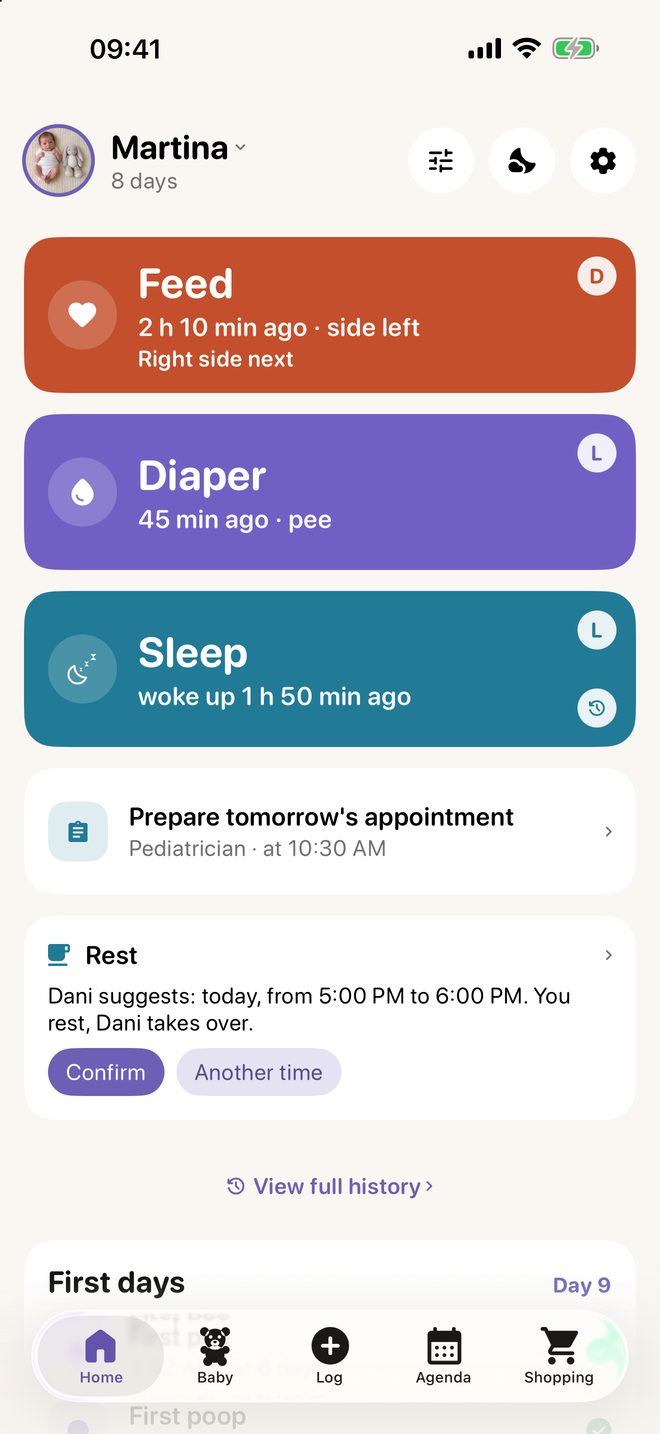
In Home, you tap the Sleep band when they fall asleep and again when they wake up. The history shows each day by the hour and the charts show how the week is going. What one of you logs, the other sees on their iPhone. For the appointment there is a PDF of the last 7 or 14 days, and the full record exports as CSV.
With Plus, Patterns summarizes what you logged: how long they are awake between sleeps, the naps and the longest they sleep at night. It is what usually happens in your home, not a recommendation.
Frequently asked questions
Do you need to track a baby's sleep?
It is not mandatory. It is useful in the first months for splitting the nights and for having data if you ask the pediatrician.
What data should you log about a baby's sleep?
The time they fall asleep and the time they wake up. From that you get naps, the total over 24 hours and the longest stretch.
How do I know if my baby is sleeping enough?
A record cannot tell you. If they feed, grow and are awake and calm at times, they are usually fine; if in doubt, ask your pediatrician.
Can I show the sleep record to the pediatrician?
Yes, and it helps. Bring the last 7 or 14 days with the sleep times and the feeds.
The essentials of Meceluna are free and have no ads.
Download on the App Store · iPhone