How many feeds a newborn has and why it helps to log them
A breastfed newborn usually has between 8 and 12 feeds in 24 hours, on demand and without a fixed schedule. Bottle-fed babies usually have somewhat fewer, and the amount is set by your pediatrician or the formula instructions.
Published on October 21, 2026.
Download on the App Store · iPhone
How many feeds are normal
With breastfeeding, between 8 and 12 feeds a day during the first weeks, day and night. That is one feed every two or three hours on average, counted from the start of one to the start of the next. With bottle feeding, the interval is usually a little longer.
There is no clock to meet. A baby who asks every hour for an evening and then sleeps four hours is very common. It is sometimes called cluster feeding and tends to happen late in the day.
How long each feed lasts
Between ten and forty minutes, depending on the baby and the day. The first days are longer because they are learning, and over the weeks they usually get shorter. If you breastfeed, let the baby finish one side before offering the other, and start the next feed on the breast that was left for last.
With a bottle, the amount depends on age and weight. Follow what your pediatrician told you or the instructions on the formula packaging, and don't push if the baby pulls away.
Signs that the baby is eating well
Watch the diaper and the mood more than the clock. A baby who is feeding well wets several diapers a day, has bowel movements, is awake and calm for a while after eating and regains birth weight by about two weeks.
Hunger signs: sucking on hands, opening the mouth, turning the head to search. Crying is the last sign: offer a feed before that. If the baby sleeps more than three hours in a row in the first weeks and hasn't regained weight, ask your pediatrician whether to wake them to eat.
Check with your pediatrician, midwife or lactation consultant if the baby refuses several feeds, wets very few diapers, or if breastfeeding hurts in a way that doesn't improve.
Why log feeds
In the first days, nobody remembers anything. Logging serves concrete purposes:
- Knowing how long ago the last one was, without waking whoever is asleep to ask.
- Alternating breasts and remembering which one the baby started on.
- Not giving two bottles because of a mix-up between the two of you.
- Answering the pediatrician when they ask how many feeds and how many diapers.
After a couple of weeks, with the data in front of you, a rhythm shows up.

How to do it between the two of you
You need a single place where whoever gives the feed logs it and the other sees it instantly. A notebook on the nightstand works until one of you takes it to the living room. Better on each person's phone.
Log each feed as soon as it ends and fix it right away if you make a mistake. A ten-minute difference doesn't matter, but a feed logged twice or not at all does cause confusion.
At night, dim light and little stimulation: give the feed, change the diaper only if needed and go back to the crib. If one of you breastfeeds, the other can take care of the diaper, putting the baby back down and logging the feed.
A stopwatch per breast, lock screen and watch
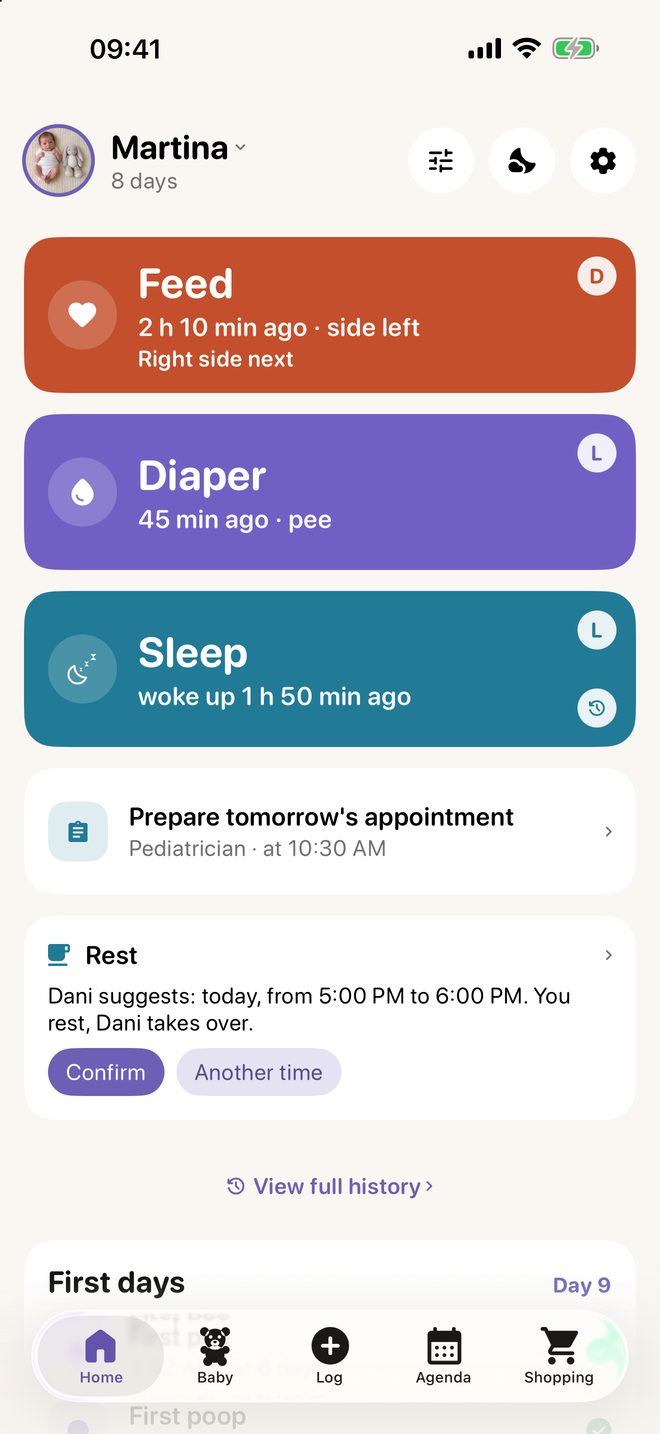
On the Home tab, the Feed band has a stopwatch for each breast, and bottles and pumping are logged with their amount. Each of you does it from your own iPhone and the other sees it on theirs, through iCloud and with no sign-up. With a feed running, the stopwatch shows on the lock screen and from there you switch breasts or finish without opening the app. If you log something wrong, Undo removes it for a few seconds.
An optional reminder tells you how many hours it has been since the last feed and lets you start a feed with one tap. On the Apple Watch you see how long ago the last one was and which breast it was. With your history you can make a PDF for the appointment. Everything together is in feeds, diapers and sleep.
Frequently asked questions
How many feeds a day does a newborn have?
With breastfeeding, between 8 and 12 in 24 hours, day and night. With a bottle, usually somewhat fewer and further apart.
How often does a newborn eat?
Every two or three hours on average, counted from the start of one feed to the start of the next. Some evenings the baby asks every hour, and that is normal.
Do you have to wake the baby to eat?
In the first weeks, if the baby sleeps more than three hours in a row and hasn't regained birth weight yet, ask your pediatrician. After that, the baby is usually left to sleep.
How do I know if my baby is eating enough?
The baby wets several diapers a day, has bowel movements, seems calm after eating and gains weight at checkups. If you have doubts, talk to the pediatrician or midwife.
The essentials of Meceluna are free and have no ads.
Download on the App Store · iPhone