First-year milestones: what usually comes each quarter, without comparing
A baby sits up between 6 and 9 months and walks between 8 and 18: the ranges are huge. These milestones show what usually arrives, and they are not an exam.
Published on November 13, 2026.
Download on the App Store · iPhone
How to read milestones
A milestone is something most babies do around a certain age, with a range of several months on each side. One child sitting at 6 months and another at 9 is within normal. What a pediatrician looks at is the overall direction: that the baby keeps gaining skills, not the exact date of each one.
If they were born before 37 weeks, subtract the time they were early: age is counted by corrected age until about two years. There is more on this in corrected age for premature babies.
What helps development most is everyday life: talking to them, singing, playing on the floor with them, giving them free time to move and not keeping them for many hours in a row in bouncers or seats. You do not need expensive toys or special stimulation.
And avoid comparisons with a friend's child or with what appears on social media. A child who is slow at one skill often gets ahead in another.
From 0 to 3 months
Around 6 to 8 weeks comes the social smile, the first real response to your face. They look at faces and follow an object with their eyes, start making soft sounds and, on their tummy, lift their head a little. By 3 months they hold it better, open their hands and look at them.
They will sleep many hours spread across day and night. At this stage there are no schedules yet, and that is normal.
From 3 to 6 months
Laughs appear, along with babbling with vowels and the urge to grab whatever is close. Around 4 to 6 months they roll from tummy to back, and later the other way. They push up on their arms, put objects in their mouth and recognize their name. By 6 months many can stay sitting with support.
It is a good time for tummy time, which strengthens the neck and back. In Meceluna you will find it as Tummy time.
From 6 to 9 months
They sit without support, often between 6 and 9 months, crawl or scoot (some skip crawling and that is fine), pass a toy from one hand to the other and start babbling with consonants, the famous "ba-ba" or "ma-ma". Stranger anxiety appears, which means they recognize their main people.
With complementary feeding, they start picking up food with their fingers. You have the topic in complementary feeding: when to start.
From 9 to 12 months
They pull up to stand holding on to furniture and some take their first steps with support. The pincer grasp, picking up a crumb between thumb and forefinger, gets finer. They wave goodbye, understand a "no" and respond to their name, and by their first birthday many say one or two words with meaning. First steps alone arrive between 8 and 18 months, a very wide range.
When to talk to your pediatrician
Ask at the checkup, or sooner if you are worried, in these cases: they do not follow with their eyes or do not respond to sounds or your voice, they stop doing something they could already do, their body is very stiff or very floppy, they do not smile or make sounds at 4 months, or at 9 months they do not sit even with help or do not babble. None of these is a diagnosis; each is a reason for a professional to take a look.
If you doubt, write down what you observe, with dates and, if you can, a short video. The checkups in the child health program include this assessment, and the vaccine and checkup schedule tells you when they are due.
A timeline to carry on your phone
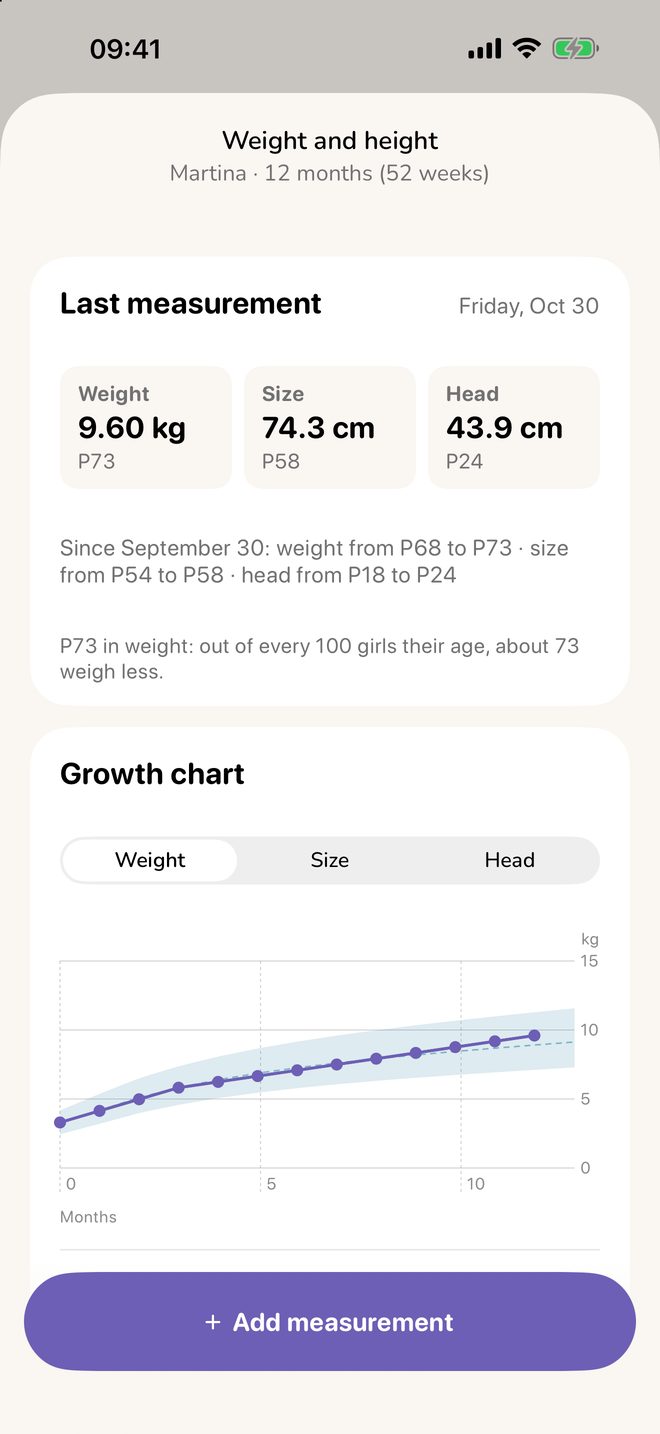
In Meceluna, the Baby tab keeps the measurements from each checkup on the WHO curves, and a note with the date of each new skill leaves you with a timeline you take to the pediatrician on your phone.
Frequently asked questions
At what age does a baby sit up?
With support, around 6 months, and without support between 6 and 9 months, with a wide range.
At what age do babies take their first steps?
Between 8 and 18 months. Many walk alone around their first birthday or shortly after.
Is it bad if my baby does not crawl?
No. Some children scoot, go along sitting or move straight to standing.
When should you worry about a baby's development?
If they lose skills they already had, do not respond to sounds or to eye contact or you notice something odd, talk to your pediatrician without waiting for the next checkup.
The essentials of Meceluna are free and have no ads.
Download on the App Store · iPhone